The district court ruled in the case, and its decision and reasoning can be read here.
Tuesday, November 19, 2013

Saturday, November 16, 2013
Justin Pavoni - Immorally Claiming the Mantle of Morality?

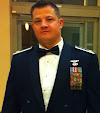
The other day I blogged about Air Force Captain Justin Pavoni, an F-15E pilot who entered the realm of public discourse with a twenty minute video interview on the Ron Paul Channel. In that interview, Captain Pavoni stated that while he is waiting for the Air Force to rule on his request to be discharged on moral grounds, he has in the interim decided that he will refuse to deploy in any combat operations. I discussed his interview and gave my view, based on the interview, that his refusal to make good on his contract with the American taxpayer was more rooted in ideological or political disagreement than it was the result of a change in morality.
Since that blog post, I contacted Captain Pavoni. We had several days of spirited private discussion. The discussion did not shed any new light on his public video interview, and it did not change my views or conclusions. Captain Pavoni and his wife (also an Air Force pilot requesting discharge on moral grounds) were invited to comment on this blog.
Captain Pavoni's story is very interesting to me, as it provides a valuable discussion of professionalism, ethics, the constitution, and the substance of not only being a commissioned military officer, but a public servant more broadly. It's the topic of morality as it relates to military officers, that I would like to further explore in this blog post.
First, I would like to pose a hypothetical question. Would a school teacher raised in a Christian Scientist family be acting morally, if they, after voluntarily entering a contract with a group of parents to educate and care for their children for a ten year term, to include administering medicine as required (swearing without any mental reservation or purpose of evasion), took $1,500,000, but then later refused to administer medicine? More simply, would it be moral for a person to violate a voluntary agreement, after monetary funds have been spent, because they personally disagreed with rendering mutually agreed upon services that are legal (but in their personal view, immoral)?
What if the contract explicitly stated that the school teacher could not simply quit? Could the school teacher claim to be taking a moral position in violating a voluntary agreement, simply because they one day decided that it was immoral to give medicine to children to cure sickness, rather than to simply pray for healing?
When, if ever, does an individual's personal morality justify morally violating a promise made to another individual, or group of individuals, after they pay for agreed upon services?
Captain Justin Pavoni went to the United States Air Force Academy (USAFA) at taxpayer expense. It is very likely that while studying at this publicly funded institution, he spent more time than the average American studying the concept and nature of war, the role of aviation in warfare, and the effects of bombs and killing people on the ground using that technology. After these years of study, it stands to reason that an average American, let alone one able to successfully get accepted to the Air Force Academy, would be able to come to terms with concepts like war, airplane, bombs, and death. They likely would also understand that upon commissioning, they would be asked to swear an oath and provide a sincere commitment - one that did not have an "I changed my mind and quit" clause. Is it possible that after all of this time and study, that Captain Pavoni did not sufficiently contemplate the nature of aerial warfare? Is it possible that he could only understand these concepts after two deployments when he was actually flying an airplane, in war, dropping a bomb, and causing death?
I've never walked on hot coals. Still, I think I can conceptualize what it would be like, and if somebody were to contract with me and give me a sum of money to walk across them - would I be justified in violating that contract after the first couple of steps, because it was only then that I experienced the displeasure of my feet burning?
Captain Pavoni completed his education and then spent years training to be a fighter pilot. Some sources say this training costs the taxpayer as much as 6 million dollars, while other sources put the number closer to 3 million. Captain Pavoni apparently completed flight training in 2008 and voluntarily incurred a ten year contract to fly for the Air Force at that point. With his decision to refuse to render services, he has now shorted the American taxpayer by roughly 1.5 million dollars for failing to render services for the last five or so years of his contract.
He maintains that since his four years of military education at a prestigious school, and after his military flight training, that he has recently come to the conclusion that flying military combat aircraft in combat is immoral.
What is morality? It depends on who you ask, of course. Some derive their moral code from religious texts and others, like Ayn Rand, claim reason and rational thought is the source of the moral life. Shakespeare would say there is no right or wrong, only thinking makes it so. So who has the correct moral code? Again, it depends on who you ask. While some moral codes have more compelling epistemological arguments than others, at the end of the day it comes down to this. Good is what I like, and bad is what I do not like. Morality is personal and subjective.
As the libertarian leaning video above demonstrates, the cornerstone of social morality might be considered to be based on voluntary exchanges and mutual consent. Or as a third grade teacher might instruct a student, "If you say you are going to do something, you should keep your word, otherwise do not promise somebody you will do something." The video above mentions that, "at times some people use force or fraud to take from others without voluntary consent."
Groups of individuals may also contract with an individual, as the video above demonstrates. Groups of individuals who have various moral codes, can agree upon basic moral tenets or positions and translate that into law, or HOA guidelines, or club rules. Religious bodies will work together for common social ends based on shared moral tenets. When a group contracts with an individual to perform a service, it is generally understood that the individual should faithfully keep his end of the mutual agreement, and should not violate that agreement because he later decides he does not want to do business with individuals who wear tacky clothes, or who wear hats, or who give their children medicine. In short, the individual has contracted to work for the group and if the group does not change its end of the bargain, the individual cannot morally change his or her end.
As military officers, we have made a contract with all tax paying Americans, to perform services in accordance with the house rules (our laws and our Constitution). We are paid by the public to execute their decisions based upon a legal public morality, and not simply based on what we personally like, or do not like. Failing to do so after receiving millions of tax payer money and training, is quite simply immoral.
The irony is that Captain Pavoni claims the moral mantle, but he does so from an immoral position which damages the group he has voluntarily contracted with. By not making good on his oath to well and faithfully discharge the duties of his voluntarily contracted office, Captain Pavoni has demonstrated that he is unfit to ever again be in any public office, and those who would voluntarily contract with him in any mutual exchange would do well to understand the term caveat emptor. Captain Pavoni has demonstrated that his word is not to be trusted.
His example should serve as a reminder to all military officers - words are important, but that does not take the place of well thought out and reasoned understanding of our professional requirements and duties. And, of course, actions matter far more than words.
Friday, November 15, 2013
The Four Horsemen - Flashy Herk Drivers
One of my favorite videos as a youngster. Before the Thunderbirds, the very first Air Force aviation demonstration team was comprised of crews who flew the mighty C-130. Great piece of history in this video, and I'm glad to see it has made its way to YouTube to be enjoyed by all.
Monday, November 11, 2013
Air Force Fighter Pilot and Wife Seek Discharge on Moral Grounds

According to the Ron Paul Channel, Air Force Captain Justin Pavoni, an F-15E pilot, and his wife (also an Air Force pilot), are seeking discharge from the Air Force on moral grounds. Former congressman Ron Paul, who served in the Air Force himself after being drafted, interviewed Captain Pavoni. Captain Pavoni has several combat deployments as a fighter pilot.
Before this story starts circulating the internet and incurring the wrath from the trenches, as any story of a military officer questioning authority invariably does, I'll offer my hasty initial thoughts on the interview and then provide my reasoning for disagreeing with Captain Pavoni's decision.
From what I gathered, Captain Pavoni's disillusionment appears to be based on government policy and use of the military since the attacks of September 11th. I can certainly sympathize with his disillusionment over government policy over the last decade or so. Captain Pavoni's concerns are shared by many in the service, and his interview reminds me of another Air Force officer who put on a mask and made this video.
In my view, Captain Pavoni does not appear to fit the conscientious objector status, at least from what little I know of it. He mentions in the interview that he's not against defending against terrorist threats, but rather he thinks the policies enacted in the name of defending against terrorism have been an overreach. He seems to indicate in the interview that a great deal of study and research over the years led to his conscientious objector position, but I would think that status would be a moral position that would have less to do with study and research. When asked how he came to his current view, Captain Pavoni stated:
I would say it was more gradual, sir, you know it's sort of some things for me didn't add up in 2009, and I was a little bit more disillusioned maybe more on the policy level than on the necessarily the moral perspective, but as I went on and researched and compared my experience with, you know, my world view, it became incompatible for me on a moral level.It seems to me that a conscientious objector is one who is morally against all forms of violence to include self defense, but of course I could be incorrect and ultimately some legal body will rule on his request. At any rate, there is nothing wrong with him requesting discharge on these grounds or any other grounds.
It becomes problematic, however, when a request instead becomes breaking a contract. When asked if he could be stationed overseas while his discharge request is considered, Captain Pavoni stated that he has made his decision, and that he will not be involved in combat operations. He mentioned that what the government chooses to do in response was out of his hands.
I disagree with Captain Pavoni's refusal to serve as he has been trained to do, although I do appreciate his courage and personal conviction. The reason I disagree is because the role of a military officer is not to follow their own personal morality, but rather to comport themselves in accordance with the collective American morality that is translated into our law. Public service is not personal service. Our Constitution and other law sets the limits of what we can and must do, and what we must refrain from doing, in accordance with the "moral" view of the American people distilled into law. Captain Pavoni has received multiple millions of dollars in training from the American people to do a job - a job he voluntarily chose to do, raised his hand and swore to do, was trained to do at great public expense, and has now refused to do in violation of the terms of his contract.
Beyond that, I think Captain Pavoni's stance is not so much a moral stance, but rather is more a simple disagreement with policy. Nowhere in the interview did he express a moral truth or moral code, but he did talk at length about disagreeing with policy. It is not the role of a military member to only execute policy they happen to agree with.
Captain Pavoni appears to be of the view that all American war is "cut from the same cloth," and that a person cannot pick and choose which actions they will participate in. This view is completely wrong. College educated military officers are expected to do precisely that - to determine what actions are legal and in accordance with our Constitution, and to refuse those which are not. In my career I have done precisely that--refusing an unlawful order to perform an illegal action, offering my resignation after being reprimanded, and nearly facing an administrative separation board or court martial. Yet, in my case, the Air Force ultimately did the right thing by not wrongly kicking me out and I remained a faithful public servant and continue to serve my nation to this day. Still, had the Air Force accepted my resignation or had it kicked me out, I still would have left with a legacy of faithfully serving my nation--I just would have paid a greater personal price for being a faithful public servant. But it's not about us when we raise our right hands. That's the essence of public service.
So, in my view, while Captain Pavoni can and should object to participating in unlawful operations (for example in Libya after day sixty without congressional approval), and while he could and should refuse illegal orders and actions within the broader umbrella of legal wars (such as assassinating an American citizen who presented no imminent threat and was denied due process of law), Captain Pavoni cannot morally join the martial profession and then refuse to provide combat capability with a blanket statement refusal. He took an oath and he is now not making good on that oath.
I do think Capt Pavoni has a valuable perspective on military policy, and I agree with his view that our actions have unintended consequences and that we are likely creating more terrorists than we are vanquishing with our actions. He has a valuable viewpoint and I agree with it, but it is not the proper role of a military officer to refuse to do as instructed by civilians who have a different viewpoint.
While I fully support any officer refusing to break the law (something they are required to do, but sadly not something we can expect government servants to do these days), I cannot support a public servant who wastes tax payer money and refuses to make good on the contract they voluntarily placed themselves in. In the military we are the stick, and not the hand that wields it. This means we may be placed in the position of doing things we find personally immoral, but so long as what we are tasked to do is legal, then we must make good on what we promised the American people--even when we personally disagree with the American people. It's an uncomfortable position, especially given the wayward policies of government over the last decade plus, but it is a position that is simply one of the many burdens of being a professional military officer controlled by an elected civilian leadership.
To sum up my thoughts, Captain Pavoni's position appears to me based far too much on his personal policy views, something that is not within his lane as a professional military officer, rather than being based on the rule of law and the Constitution, which is precisely within his lane as a military officer. I do appreciate his courage though. But I disagree with his decision to refuse to carry out his voluntarily accepted contract. I can also agree with him that it is in the best interest of the American people for him to be discharged, now that he has violated his oath of office. Our oath of office isn't just something that requires us to occasionally and courageously say no. More often than not, our oath requires us to salute smartly and execute even when we disagree.
Friday, November 8, 2013
Ben Swann Appreciates Veterans who Defend the Constitution
In the video above, Ben Swann expresses his appreciation for the Veterans Against Police Abuse (VAPA), a group of people dedicated to fusing technology and legal action to help Americans protect themselves and their constitutional rights.
Swann's sentiments are well timed, as we all take a couple of days to remember the sacrifices of those before us, who gave everything to support and defend our Constitution from all enemies foreign and domestic. I hope that this Veterans Day, we can think about why that really matters and ask ourselves what is really so important that we send our sons and daughters to bleed and die on foreign grounds. What is at the heart of this commitment and why does it truly matter?
The answer is America. America is worth defending, and as Edward Snowden stated, America is worth dying for. America isn't just lines on a map, or an affiliation by birth like cheering for the local football team. America is principle and reason and character and values and was truly the greatest nation ever created. Those values and principles, which seem so distant these days as they are frequently demonized in the present, make America worth fighting and dying to protect.
To truly defend something, one must truly value something.
I'd like to echo Swann's appreciation this Veteran's Day weekend, and give thanks to those who have raised their right hands and who know and who value and who truly defend our Constitution-- who often defend it from those who also raised their right hands and yet do not truly know or value that same document.
If America is ever to be restored to its greatness, it will take all of our peaceful and collaborative and courageous actions with a healthy dose of American ingenuity. There is no better time to be a great American than right now, to be a great American like Ben Swann, the best news journalist in the nation, who offers his skills to benefit truth and liberty, rather than to merely collect a paycheck. Being a great American who defends his nation requires no military experience at all.
Happy Veterans Day weekend.

Saturday, November 2, 2013
Enemy of the State - A Movie That Became Reality
I remember watching this movie when it first came out. Very entertaining and it raised important points. I then remember watching this movie become a reality. America is seeing it more clearly now than ever. I remember the Patriot Act being discussed in this movie's fake media, as it was later discussed in real fake media.
The movie is worth a watch and it's entertaining as only Will Smith, Gene Hackman, Jon Voight, Jack Black, Seth Green, and Jason Lee (of Kevin Smith Clerks/Chasing Amy fame) can deliver.
The movie is only entertaining because it is perhaps the ultimate example of Deus Ex Machina. The reality is God will not save us.
The NSA's Continual Violation of our Constitution

There is an exceptionally well done interactive website that discusses the systemic, egregious, and completely inexcusable violation of the rights of Americans by the National Security Agency (NSA). The website linked above brings in great legal minds and a couple of members of Congress to provide a rich look at the agency's routine violation of our Fourth Amendment to our Constitution. Scroll down that site to have the issue explained in great detail.
I recommend every single military person visit this page and review the content in its entirety. This is information you need to know if you are to be well prepared to honor your oath; your solemn promise to the nation, and the taxpayers who pay you to not infringe on their rights to be free from unreasonable searches and seizures.
Nobody said it would be easy. Do the right thing, not the easy thing. There is no choice but to risk yourself to do the right thing while you serve. If that's too much for you, get out of the military now. Don't walk, run. For those who remain, you may get one chance to do the right thing while you're in - and if you fail during that opportunity, then you're a failure. No stratification, no wing award, and no rank or position will ever be able to change that fact. If you get tested, you must be ready. Against all enemies, foreign and domestic. Don't be on the wrong side of that line.
If you need a tip on what it means to truly serve, consider the example of former Navy SEAL Mike Janke.
Saturday, October 12, 2013
A Trickle Approved for TERA

According to Stars & Stripes, the recent and very limited Temporary Early Retirement Authority (TERA) offer led to more than 350 airmen retiring early. They must be retired one month from today.
According to the article, the 311 enlisted and 47 officers who were approved for the program, broke down as such:
The military rank of the majority of applicants approved — 201 — were technical sergeants, according to Dickerson. There were also 110 master sergeants, 31 majors, eight captains and eight lieutenant colonels.Seventy-nine of the approved applicants had 15 years’ active-duty service; 66 had served 16 years, 81 were at 17 years, 95 completed 18 years, and 37 had 19 years in the books.
Those are some pretty interesting statistics, particularly the number of folks with 18 and 19 years who took the retirement penalty to retire just a little early.
The article also states that the Air Force expects to announce involuntary separation programs soon. As a person who applied for the TERA program and was told I was not eligible, I'm particularly interested to see what happens next.
I predict those who were not eligible for this voluntary separation program, will find themselves more than eligible for coming involuntary separation programs in FY 2014.
I predict those who were not eligible for this voluntary separation program, will find themselves more than eligible for coming involuntary separation programs in FY 2014.
Interesting times we live in.
Tuesday, October 1, 2013
The Power of Water

“Dripping water hollows out stone, not through force but through persistence.” - Ovid
Water is really under appreciated. Not simply because all life requires water, but because water is one of the most powerful symbols to ever exist and yet it rarely gets any credit. Perhaps that's actually part of its power.
Water can easily navigate around obstacles, over, under, around or through them. Little to nothing is impervious to water.
If water wants in, it will get in, despite your best attempts to keep it out. It will change forms from gas to ice and play the slow game if it must, but you can count on it showing up time after time. It will be patient and it will slowly carve large unmovable rocks, and cut them down to size if that's what it desires. Just as it did in that big canyon in Arizona. Just as it has done throughout the world taking on the form of a glacier.
As Ovid said, "Guttaa cavat Lapidem" - dripping water carves a stone. Water is very persistent.
A puddle of water, splish splash. A hail storm. An iceberg. A cloud. Water is a shape shifter. Add a few basic elements to it, and it will change color and take on new properties. Water is the ultimate chameleon.
But most importantly, water cleanses. It washes away stains.
One way or another.
There is a lot we can learn from water.
Monday, September 30, 2013
Brilliant Leadership From General Welsh
It's not often I get to sing the praises of a senior leader in our service, but I really enjoy the rare opportunities I have to do so. I was given a great opportunity a couple of weeks ago, thanks to the current Air Force Chief of Staff. General Welsh, in perhaps the perfect textbook act of leadership, empowered all airmen in our service to do what makes sense for mission and people, even if that means not following a regulation.
The Air Force Times did a good job seizing on the most important aspect of the General's speech, quoting the CSAF stating, "We’ve got a lot of frustrated people out at the front end of the Air Force who don’t understand why they are given guidance to do things that don’t make any sense to them." The guidance General Welsh gave:
If it doesn’t make common sense, if it doesn’t make the mission better, if it doesn’t take better care of our people, then just don’t do it and tell your boss...
That may sound revolutionary or perhaps even naive to some. But it most certainly is not. It is brilliant and it is combat tested. Robin Olds comes to mind. But there are also modern examples. In my years flying the AC-130 Gunship for Air Force Special Operations Command (AFSOC), each time we got a new squadron commander, unfailingly we were told at the very first commander's call that if we knew the regulations and broke them to get the mission accomplished, our commander would have our back. Each commander followed that up with a reminder that if we broke regulations because we did not know them, they would fry us. This was not an invitation to suck, to be lazy, or to not care. I want to emphasize that every single squadron commander gave that disclaimer up front (four commanders in my time spent in the community). They told us this, because it was important and they knew we were dedicated and mature enough to think and to get the mission done successfully. And we did. And we were truly exceptional doing it.
General Welsh has empowered us the same way. For those who think it was just a speech, the Air Force Times article tells us General Welsh claims he is "dead serious." In the video link above, you can witness the Chief saying it. Beyond that, I have heard other senior leaders echo this sentiment, pointing to these specific words from the CSAF, to those who complain about the myriad of serious problems we suffer in our air service. In the video above, the CSAF says that the MAJCOM commanders understand his guidance. In the political reality in which we live, where so many military officers psychologically trade in their uniforms for the clothes and fake smiles of politicians, I understand mistrust of those who climb the ladder. I certainly reserved a bit of mistrust for General Welsh when he took command.
But listening to him talk about his father, and his father's amazing acts of service, in addition to the obvious qualities General Welsh brings to the table, was enough to earn my trust. You simply don't have a father like Colonel Welsh and not care. It's not possible. You don't become CSAF without being intelligent and competent. Caring, intelligence, and competence is a superb combination.
The BLIM is this--if you are acting in the best interest of the service and the nation, regardless of the friction that might cause, your service will not be lost while General Welsh is at the helm.
I would, however, advise all to remember the words of my ghostly commanders from the past. Know the regs, know the mission, and be doing the right thing for the mission. Maturity. Authority brings responsibility. Study before treading lightly.
The gauntlet has been thrown down, and it's not just words from a speech writer. The boss has gotten the message out, and it's trickling down. There should be no misunderstandings, and there are no longer any excuses for not getting it done. There is, however, a responsibility to mentor our peers and subordinates on the maturity required to handle this increased authority that each of us has been given to take care of mission and people.
General Welsh threw the gauntlet down. While he fights for resources in a tough environment, he has given us the green light to do what makes sense for the nation. It's time for us to pick the gauntlet up, and take care of business for the American people. General Welsh has our back.
Subscribe to:
Posts (Atom)

 Posts

